Pebble Index: from 20% to 2% wrong, thanks to Jev
The problem
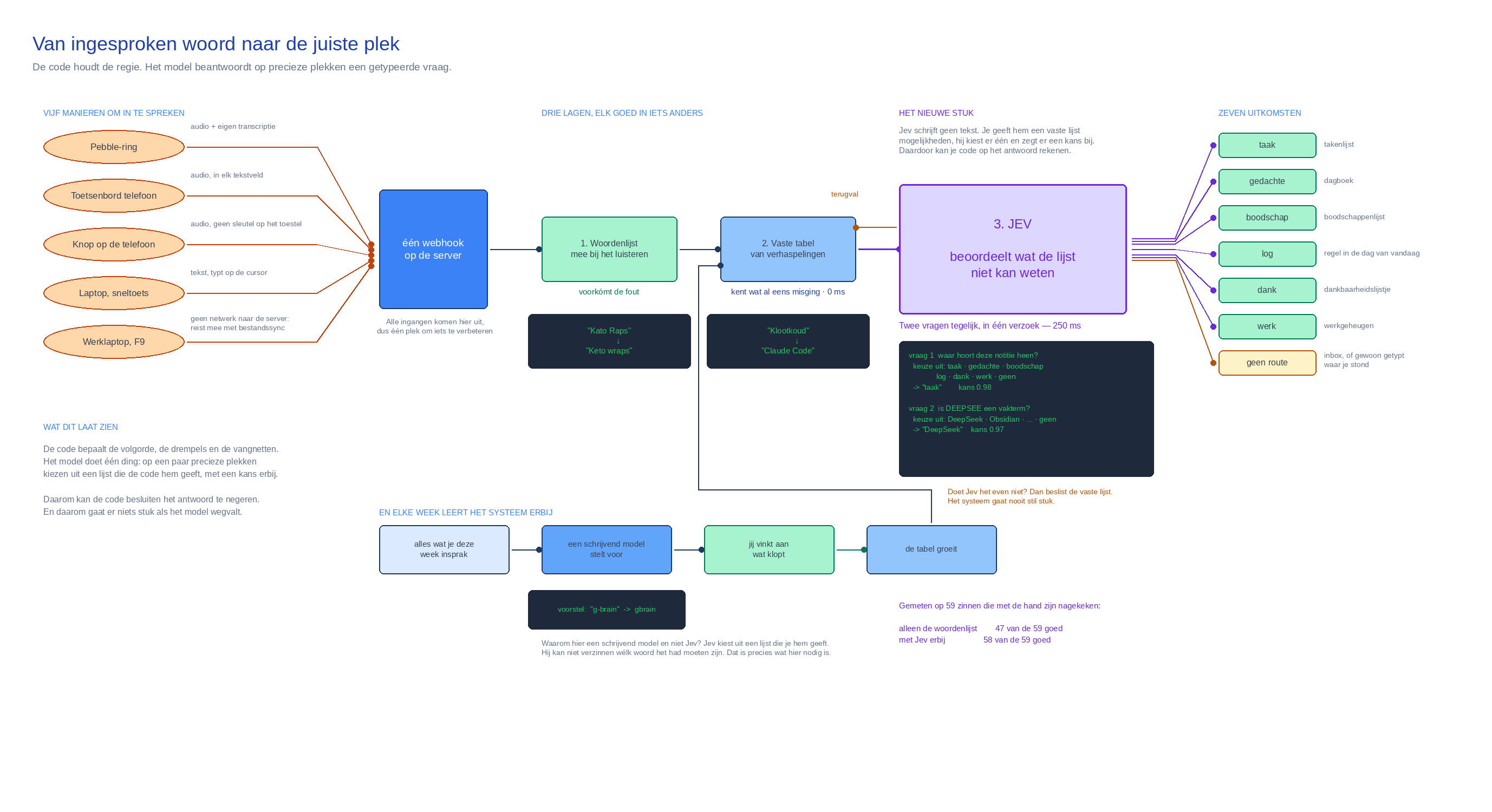
Michael wears a Pebble Index 01: a ring you speak a short note into. The first word decides where it goes: “taak” (task) becomes a task, “gedachte” (thought) a journal note, “boodschap” (shopping) a line on the shopping list. But speech recognition doesn’t always hear right. “Taak” becomes “paak”, and the note lands in the wrong place. A word list of known mishearings caught some of that, but it only learned about a mistake after it had gone wrong once. One in five notes went wrong.
The solution
On 15 September TypeSafe released Jev: a small model that doesn’t write text, but picks from a fixed list of options and returns a probability. Three days later it was in the ring. The question to Jev is simple: which of these seven routes is this, or none?
flowchart TD
  A["Spoken note<br/>ring, phone or laptop"] --> B["Word list<br/>sent along with the transcription"]
  B --> C["Fixed table<br/>of mishearings"]
  C --> D{"Jev picks:<br/>which route, or none?"}
  D --> E["task · thought · shopping<br/>log · thanks · work"]
  D -->|"none"| F["inbox"]
  C -.->|"Jev unavailable"| E
The full diagram (in Dutch), with every way to dictate and how the system learns each week: view full size.
What it gets you
On 59 hand-checked sentences:
| Right | Wrong | |
|---|---|---|
| Word list alone | 47 of 59 | 20% |
| With Jev added | 58 of 59 | 2% |
And it’s fast and dirt cheap. An answer typically arrives in 250 milliseconds, and that one request carries two questions at once: where does this belong, and is there a misheard technical term in it? All 59 test calls together cost $0.0021. A thousand spoken notes cost a few cents.
The code stays in charge; the model answers one precise question. Because Jev only picks from what the code offers, it can’t make anything up: at worst it picks wrong, and that you can measure. If Jev is unavailable, the old list decides again, so the system never stalls. A small, fast model like this doesn’t need to be smarter than the big ones. It needs to sit in the right place.
Try it yourself
Got a script that sorts free text by keywords (speech, email, forms)? Give this prompt to your AI assistant:
My script routes text based on a list of keywords and variants. Build a
test: collect 50 real examples, label each with the correct route, and
measure how many my current list gets right. Then ask a small
classification model the same thing as a multiple-choice question: give
the routes as fixed options plus "none", and let the model only choose.
Keep the old list as a fallback. Compare accuracy, speed and cost per call.